Freight forwarding software for Tanzania
Kani LMS is freight forwarding software for Tanzania that gives every job its own file, from the quotation to the paid invoice. Your team, your customer and your accountant all work from the same record.
Who it is for
Freight forwarders in Tanzania who arrange shipments for customers and want to know, shipment by shipment, what they quoted, what it cost and what they earned.
Freight forwarding software built around the shipment file
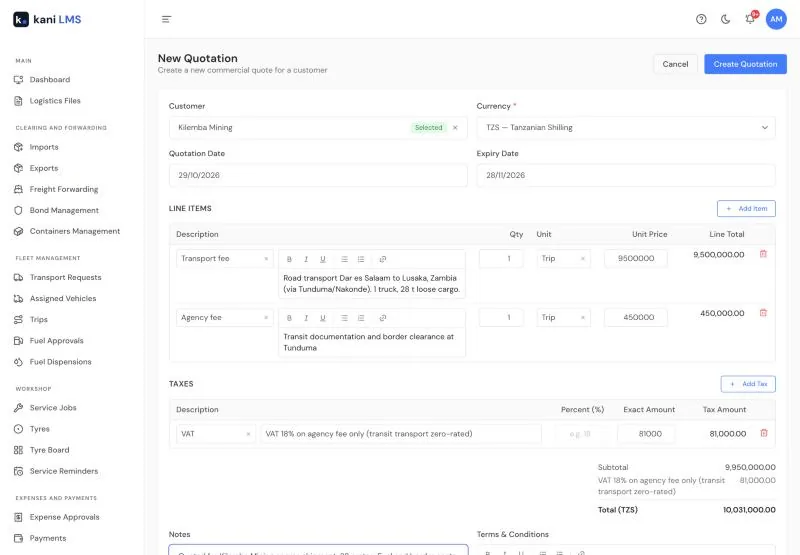
Quote first, then run the job from the same record
Prepare the quotation in Kani LMS, link it to the file, and turn it into the invoice when the work is done. Nothing is typed twice.
One file for every shipment
Booking, MBL and HBL references, parties, route, cargo and the ETD, ETA, ATD and ATA dates live in one place, with daily status updates. Choose sea, air, road, rail or multimodal, import, export or cross-trade, and record the Incoterms.
Each shipment moves through nine stages, from Draft and Booked to Customs Clearing and Delivered. No more searching through a paper file or a WhatsApp group.
Know what each shipment cost
Every cost is requested against the file and goes through two levels of approval before payment. The file shows profit or loss as costs come in. More on expense approvals and profit per file.
Customers and suppliers in one list
Keep their details once and use them on every quotation, file and invoice.
Daily reports for you and for your customers
Owners get a daily summary. Customers can receive updates without calling your office.
Invoices that reach your accountant
Approved invoices and expenses go across to QuickBooks as you work.
How it works
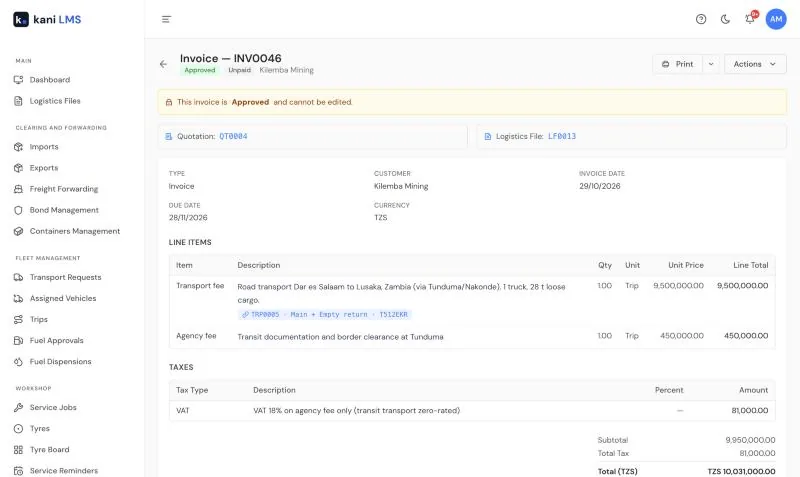
- Quote the customer and link the quotation to a new file.
- Move the shipment through its stages, adding costs and updates as they happen.
- Invoice from the file and read the profit.
Questions and answers
What is freight forwarding software?
It is software that helps a forwarder manage shipments for customers: the quotation, the documents, the costs, the invoice and the profit, in one system instead of several files.
Does Kani LMS handle imports and exports as well as freight forwarding?
Yes. Imports, exports, freight forwarding and transport jobs each have their own files in the same system.
Can I keep my customers updated?
Each file carries daily status updates, and Kani LMS can send daily reports to your customers.
Will it replace our spreadsheets?
Kani LMS is built to replace the paper file, the spreadsheets and the WhatsApp group that many small forwarders run on.
How much does it cost?
TZS 30,000 per user per month, with every feature included. The minimum is 3 users.
TZS 30,000 per user, per month
Every feature is included. The minimum is 3 users, so you start at TZS 90,000 a month.
See full pricing and training options · Read the Kani LMS user guide